I asked Chat GPT to compare and contrast Heidegger and Hegel, and this is what it came up with, verbatim.
Chat GPT on Hegel and Heidegger:
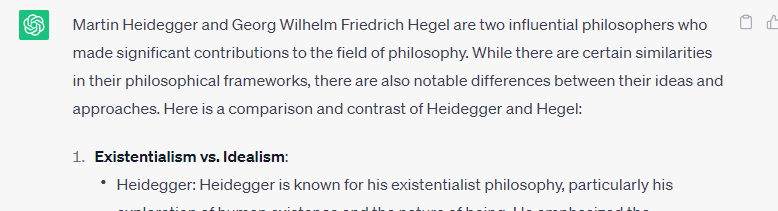
“Martin Heidegger and Georg Wilhelm Friedrich Hegel are two influential philosophers who made significant contributions to the field of philosophy. While there are certain similarities in their philosophical frameworks, there are also notable differences between their ideas and approaches. Here is a comparison and contrast of Heidegger and Hegel:
Existentialism vs. Idealism:
Heidegger: Heidegger is known for his existentialist philosophy, particularly his exploration of human existence and the nature of being. He emphasized the individual’s subjective experience, the concept of “Dasein” (being-in-the-world), and the search for authenticity.
Hegel: Hegel, on the other hand, is associated with idealism. He developed a comprehensive philosophical system that sought to understand reality as a dialectical process. Hegel believed that reality is shaped by the dynamic interplay of opposing forces, leading to the development of higher forms of consciousness and societal structures.
Being vs. Absolute Spirit:
Heidegger: Heidegger’s focus was primarily on the question of being and the human experience of existence. He explored concepts such as “being-towards-death,” the temporality of existence, and the significance of everyday activities in shaping one’s understanding of being.
Hegel: Hegel’s philosophy centered around the concept of Absolute Spirit, which represents the unfolding of consciousness throughout history. He posited that the development of human knowledge and self-awareness occurs through a process of dialectical progression, culminating in an ultimate realization of Absolute Spirit.
Ontology vs. Epistemology:
Heidegger: Heidegger’s primary concern was with ontology, the study of being and existence. He delved into questions about the nature of reality, the relationship between being and time, and the role of language in shaping our understanding of being.
Hegel: While Hegel also engaged with ontological questions, his philosophical system extended beyond ontology to encompass epistemology and metaphysics. He explored the nature of knowledge, the dialectical development of concepts, and the idea that reality is fundamentally rational.
Philosophical Methodology:
Heidegger: Heidegger employed a hermeneutic phenomenological approach, focusing on interpretation and understanding. He emphasized the importance of studying everyday human existence and engaging with the historical and cultural contexts that shape our understanding of being.
Hegel: Hegel’s methodology involved a systematic and dialectical examination of concepts, starting with a thesis, encountering an antithesis, and culminating in a synthesis. He believed that truth emerges through the resolution of opposing ideas, leading to a higher level of understanding.
Legacy and Influence:
Heidegger: Heidegger’s ideas have had a significant impact on existentialist philosophy, hermeneutics, and phenomenology. His exploration of being and his critique of technology continue to shape philosophical discourse.
Hegel: Hegel’s philosophical system has had a profound influence on various areas, including philosophy of history, political theory, and sociology. His dialectical framework has been influential in shaping subsequent philosophical, sociopolitical, and cultural thought.
While both Heidegger and Hegel explored fundamental philosophical questions, their areas of focus, methodologies, and philosophical frameworks differ. Heidegger emphasized individual existence and the nature of being, while Hegel’s idealism centered around Absolute Spirit and the dialectical development of consciousness.”
Conclusions
Now, these two philosophers have inspired a lot of deep thought in me that have resulted in what I hope is interesting reading, and it is certainly possible for a seasoned thinker to come up with something deeper and more worthwhile than what Chat GPT has produced, here. However, this is certainly up to the standards of any undergraduate course, and upper level academics, moving forward, are going to have to step it up.
The academy has largely driven out right wing thinkers. Consequently, anyone who is on the right has been forced by the market to become truly thoughtful and original. Arguably, this means that right wing thinkers are far less vulnerable to being replaceable by AI. In other words, your tenure no longer matters if no one needs to go to your school. Meanwhile, the job market now requires far fewer college educated white collar workers; therefore, the jobs that remain will require workers to actually be independent thinkers. That is to say, it requires the types of thinkers that the current leftist academy is unable to produce.


Leave a comment