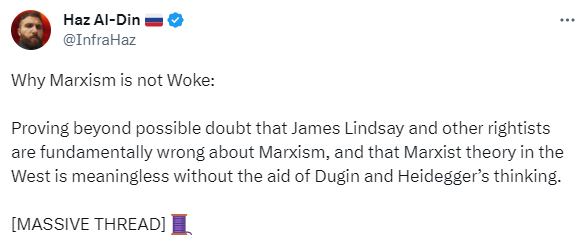
On June 23rd, 2023, a noted, controversial public figure and Communist philosopher going by the nom de plume of “Haz Al-Din” published his first explicit written statement of philosophical doctrine on Marxism as such in the form of a tweet thread.
Who Is Haz Al-Din?

Haz’s real identity is not known to the public, but he’s a former law student turned streamer, philosopher, and political organizer who grew a following during the pandemic shut down of 2019-2021 (at time of writing, shut down conditions still apply in certain territories, but in most places, the shut downs completely ended 1-2 years ago). He is a self-described “MAGA Communist” who views the MAGA (“Make America Great Again;” the slogan coined by President Donald Trump in his 2016 presidential bid) movement as the only authentic proletarian movement in recent USA history. He views this movement as consistent with his own Marxist-Leninist and Stalinist views. He reviled by most other Communists in the USA, who tend to have Fabian sensibilities, rather than Stalinist ones.
Haz’s Following
His following (among whom I count myself) comes from various cultural, ethnic, religious and ideological backgrounds, but tend to skew male and straight. His views tend to appeal to high-testosterone males because they call for discipline, self-reliance, individual judgment, patriarchal family values, and a political structure that is minimalistic, yet also hierarchical and absolute. He compares figures like Vladimir Lenin and George Washington and finds that they have far more in common than not. He advocates simultaneously either nationalizing or dissolving and redistributing the largest corporations, while radically rolling back regulations and taxes for sole proprietorships and small businesses. As an aside, this stance is, in some ways, a direct inversion of the present situation, which makes it profoundly revolutionary.
He also advocates the whole-scale dissolution of the services industries. This is, prima facie paradoxical, given his general attitude towards small business. However, it is consistent with his pro-working class orientation. Service workers, in his view, are explicitly excluded from that class, because their loyalty is naturally to the bourgeoisie, which he identifies as the financial capital class. This is in sharp distinction to the view of most Western followers of Marxism, but is an internally consistent stance. He excludes well-off blue collar workers and business owners from this (bourgeois) class, which is likewise in distinction from other communists in the West.
Ron Paul Maoism
He is apt to praise Joseph Stalin and Ayn Rand in the same breath. This paradox is also consistent below the surface. He views the blue collar worker and business owner in the same way Rand does. He diverges with her view where it concerns the managerial class. In the present context, this makes sense. The average member of that class is the absolute furthest thing from the Objectivist prime mover ideal. This class shamelessly and enthusiastically supports and serves the Fabian woke ideal. Most of them are the epitome of the Nietzschean “last man.”
On the other hand, he considers Stalin and Mao to be among the most misunderstood figures in history. In his view, these two had fundamentally libertarian instincts, yet were informed by a materialist dialectic. They are misunderstood because western libertarians lack an understanding of the historical context and the Hegelian tradition. His arguments, backed up by historical citations, are surprisingly compelling.
The Essay
Although Haz has been a fixture in the vlog-o-sphere for the last few years, and although he has created some written content, he has never produced an explicit expose on Marxism per se until two days ago (as of writing). I, myself, personally anticipated this document for months, given his absolutely unique, compelling perspective on the subject. His thesis is that Marx, in the Western context, must be read through a phenomenological – and specifically Heideggerian – lens. What follows is my carefully considered analysis of that document.
What is Marxism?
“§2 To begin, what is Marxism? Marxism is not a theory of equality. It is not a diagnosis of injustice, nor is it a specific prescription of how to remedy society’s ills. Marxism is a method for acquiring knowledge about the laws governing the historical development of societies.”
Right at the outset, he frames the subject as a science, as opposed to a “specific prescription.” As will become clear later, he means “science” in the pre-modern understanding of sciencia. This immediately differentiates it from the modern post-Cartesian idea that most Western Marxists have.
“But the reason Marx’s contemporaries called him Prometheus is because he bequeathed a science that did not just describe reality, but participated in its development.
“§4 This makes Marxism totally contrary to modern science. Modern science places knowledge above its object. To know, means to strip something naked to consciousness and turn it into a utility for the knowing subject. He who knows an object, can control, master, and alter an object.“
Here, he places the science of Marxism in opposition to modern science. This sets up Marxism as anti-Cartesian. This, in turn, underscores its consistency with the Heideggerian perspective.
“§5 But the ‘object’ known by Marxism is none other than human society itself. And the paradox lies in the obvious fact that society is not just an object, but also a subject. Marxists (subjects) are themselves part of the very object they make knowable.“
Here, he sets up the fundamental problem – the subject/object problem. For much of the essay, he will describe how this problem invalidates Western interpretations and necessitates a phenomenological approach.
“§8 For Marx, the knowledge of historical laws arrived at by consciousness, was being reflected in history itself. Knowledge of humanity does not dominate humanity, but reveals that it was there, and part of it all along…
“…In reality, the role of Marxists lies in spreading the ‘good news’ to the despairing proletariat.”
This alludes to Marxism as being part of the Hegelian tradition applied to the historical and material conditions of the working class. This is a well understood aspect of Marxism.
“§12 Without the guidance of proletarian consciousness, the movement propelling society still continues. But it leads to an economic, political, spiritual, moral and overall social crisis. Society eats away at itself as it cannot make sense of the contradictions driving it.”
I have personally been in denial of this all of my life. It’s not that I failed to see what the financier class was doing to the American working class, but I always managed to blame the government for allowing it, instead of holding them to the same standards they held average Americans, and failing to protect the people who elected them.
I now realize that it’s not that that’s false; but it’s an inevitable eventuality of the system as it exists. To preserve American values, a workers’ movement is necessary. The MAGA phenomenon is such a movement.
Where Does Western Marxism Go Astray?
Ҥ13 The crisis of Western Marxism lies in its inability to overcome the subject/object distinction when it comes to society. How can society both be a real (material) object, while also given the quality of subjective responsibility? Two responses emerge:
Ҥ14 The first cope of Western Marxism is a type of fatalism, which Lenin calls economism. According to this view, politics is not involved in the revolutionary transformation of society at all, which happens only because of economics, or a spontaneous uprising of the proletariat.
Ҥ15 The second (more relevant) is the opposite extreme. In this view, society must act as a pure subject in the form of institutions (party or otherwise), exterminating every trace of its pre-conscious, and objective material being, recreating all society from scratch.
“§16 But both two sides of Western Marxism are incompatible with Marx’s Promethean gesture of suspending knowledge back to being. In the first, being is upheld entirely independent of knowledge. In the second, knowledge is asserted over and at the expense of being.“
Here, he lays out the core conflict of the essay. In my own reading of Hegel (in this context, a precursor to Marx), I found Heidegger’s work on Dasein to be absolutely instrumental in grasping it. So much so, that I asked Chat GPT to compare and contrast the two thinkers. However, without this frame (as it were), Western thinkers tend to interpret Marx in one of the two ways he describes.
What he’s describing is the consequence of the intellectual dominance of Cartesian dualism as it meets Marx’s dialectical materialism. Is society the unextended thing, or the extended thing? Soul or matter? Is it conscious, or does it obey some fixed Newtonian schema? Either way, it warps the very idea of a dialectic. Only Dasein can redeem it. Haz explains in depth.
Gyorgy Lukacs
Full disclosure: I have not personally read any of the works of Lukacs! I am taking Haz’s analysis of his work at his word, here.
“§21 This Western Marxism has its origins in the neo-Kantian György Lukács, whose seminal work “History and Class Consciousness” was written to resolve the problem the subject/object distinction posed for the Marxist concept of society, class & history...
“…§24 Society was ‘objective,’ and consciousness was ‘subjective.’ Their dialectical interaction, for Lukács, was the basis of history itself. But the material reality outside of social mediation (nature) was irrelevant to, and outside this dialectic, outside history.”
In addition to the Cartesian and Kantian influence, here, there is also something of a Tabula Rasa at play, here (if I’m understanding it correctly). If nature has no say, then all that is objective about society can be reshaped through subjective command and control. This interpretation does appear to be consistent with what describes later on:
“§27 Without including nature in the definition of material reality, then class-consciousness consists in dissolving all society, in all its objectivity, into a pure subjective self-consciousness. For Lukács, the proletarian class is the first ‘subject-object’ which does exactly this.
“§28 This is a gross perversion of Marxism, and it is easy to see the lineage of the Lukácsian view in the Frankfurt School, the New Left, ‘postmodern academia,’ gender studies in Wokeism as a whole…
“…§33 Wokeness is just the applying it to the realm of culture, where the unwritten norms of civilization secretly disguise relationships of injustice, oppression, and marginalization – by virtue of not being premised by expressly consensual, rational, etc. consciousness.
“§34 In bourgeois modernity, only what is in the sphere of explicit responsibility of conscious subjects can be ‘trusted.’ Any recognition of humanity in reality itself is no different than a superstition: Reality is arbitrary, meaningless, and malign. Only institutions are Good.“
If this does not precisely capture the mindset of the Tavistock Institute and their various induced maladies that currently afflict modern culture due to their influence, then I don’t know what does. This is A Brave New World boiled down to its essence. This is the whole Fabian project in a nutshell.
“§44 Having rejected any specific form of being as necessarily material, including nature, it is only upon failing to render the Totality fully transparent that consciousness may renunciate its aspiration to dissolve everything in itself. Totality is the Lukácsian sublime.
Ҥ45 The Totality of individual relations in the form of History, or Society, constitutes a type of absolute objectivity which is not merely a reification Рbut the free, continuous and holistic content of every possible experience, mental state, and subjectivity.
“§46 A totality cannot assume self-consciousness, since it cannot be confined to any one self. So that is simply the end of Scientific Socialism: The only thing that can really be known about society, is that nothing at all can be known. This is no more knowledge than Kant’s Thing.
“§47 Subject-Object distinction reemerges, only now between a subjective self-consciousness (in the form of Party, institutions, etc) rendering transparent and assuming responsibility for all determinations of society and the Totality of relations as the supremely impenetrable object.“
In other words, this idea leads to the most unbearable form of tyranny, because it knows no limits. There is nothing that can be beyond its grasp. Not your property. Nor your money. Not even your family. Or even your right to defend yourself. Not even your right to think thoughts to yourself can be placed beyond their control.
If there is no nature, and only the institutions may dictate the good, then God help you. These people want your children. If you don’t explicitly reject this, they will have them.
I don’t believe that this is what Marx had in mind by a materialist dialectic. I certainly hope not. Yet, if you think I’m exaggerating, you need look no further than the Tavistock Institute and the current push to expose children to pornography in schools to see that I am not.
“§53 The very distinction between subject and object itself is not at all clear in Western society, which is extremely sensitive to algorithmically-driven shifts in culture. Even scientific consensus is (rightfully) called into question, while expert opinion disguises itself as fact.”
This is the direct consequence of this approach to guiding a society. A “post-truth” mindset invalidates you.
Evald Ilyenkov
Again, full disclosure, while I am familiar with Spinoza, I am not at all familiar, from my own reading, with Plekhanov or Ilyankov, and am taking what Haz says about them, here, at face value.
Ҥ56 Marxists as early as Plekhanov have also opted for regressing into Spinozism as a means to resolve the problem, where subject and object collapse into the supreme Substance. In this way thinking consciousness is the mere attribute of Substance: the most fundamental form of Being.
“§57 Soviet Philosopher Ilyenkov, goes so far as to draw out speculative cosmological implications of this view, according to which thought arises as a necessary attribute of matter to prevent the heat death of the universe, by initiating a conscious cosmic catastrophe to reset it.“
I am personally more apt to fall into the Spinozist trap than the Cartesian one.
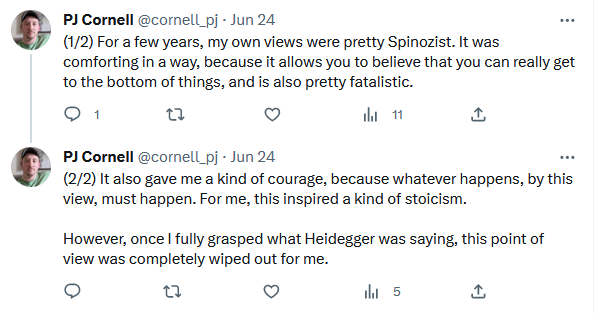
“§58 The problem with Spinozism is not the view that mind and matter (‘subject and object’) share reality, but in the notion of reality as ‘Substance:’ a metaphysical view of the object already united with its subjective determinations. Substance thus has no stake in its attributes.
“§59 This is just one of the ways of ‘resolving’ the problem by denying it all together: Substance is mere objectivity given Form by the mind. Substance is treated as supreme, antecedent, and given, but it is the repository of a dogmatic subjective determination, not true objectivity…
“…§63 In practice, it becomes a type of ideological hubris, asserting the unreality and meaninglessness of every actually substantive bond of civilization, in favor of a supreme ‘Substance’ that has neither any skin of its own in the game, nor any reality outside a calcified intellect.
“§64 More importantly, it renders Scientific Socialism into a metaphysical dogma, incapable of deriving concrete knowledge of concrete social reality. No specificity of societal objectivity is possible – everything is just ‘capitalism’ permeating the whole of its ‘attributes.’
“§65 It is obvious that if ‘everything’ is objective, then nothing in particular is, including society itself.”
What he’s saying is that this idea of radical determinism ossifies everything essential about man and civilization. There is nothing at stake because everything is determined. There’s also no way to differentiate one thing from another; everything is a Newtonian Rube-Goldberg machine.
While this may be technically impossible to disprove, it also makes further assay into the social subject meaningless. There’s no reason to accept it, and if you do, there’s nothing further to be said.
What’s more, If you are a Spinozist, you cannot engage in an authentic dialectic. Consequently, you cannot apply Hegel or Marx at all in that case.
The Reason True Marxism is Currently Inconceivable in the West
In contrast to Western cultures, Eastern cultures have not fallen under the dominance of the Cartesian method, and, as such, retain the ability to take nature for granted. This unburdens them from the main obstacle to authentically applying Marxist ideas within their society. By respecting their own peoples and cultures as they are, and being responsive to them, the Marxist ideal acquires a certain organic property which Western Marxists have failed to replicate.
Ҥ71 Marx and Engels failed to fully transmit their theoretical genius. Lenin alone inherited it, and gave it practical reality. The genius of Marxism survived as the genius of world-historical statesmen and civilizations, but its original spark of consciousness was lost.
Ҥ72 Marxism-Leninism emerged as a type of phronesis, whose advanced outlook was established by the context of the concrete historical experience of Communism. Not strictly a matter of theoretical intellect, but also a type of advanced sensibility based on practical reality.
“§73 Marx’s Promethean gesture acquired objective reality and history exclusively outside the West, where objectivity of society was not metaphysical question, but a given reality. And the problem of metaphysics permeated the whole of Western thinking, not just Western Marxism.
“§74 For Marxism to be meaningful in the West, it cannot ignore this problem, for when it does, it always remains trapped within it anyway, inevitably regressing materialist objectivity from practical Scientific Socialism into the scholastic Kantian or Spinozist frame.“
Like fish in water, we in the West are, for the most part, not even conscious of the extent to which Descartes’ radical doubt and method has shaped every aspect of our thinking and habits. It has reached such heights, of late, that it has become a kind of religion.
In A Brief History of Time, Stephen Hawking goes so far as to claim that modern science, the ultimate accomplishment of the Cartesian method, has made philosophy itself obsolete. This is absurd on its face. Modern science is not even equipped to engage with the questions of philosophy. This was proven as far back as David Hume in his exposition of the “Is-Ought” fallacy. And yet, this book was published by one of the most revered academics of recent history, and was well received.
With this sobering fact in mind, is it any wonder that the very concept of a materialist dialectic escapes us on a civilizational level?
The problem with this is that the Cartesian philosophy, while a powerful tool, is the wrong tool for the job when we’re concerned about the meanings and essences of things. Yet, when we are talking about social forces, meaning and essence play a central role, far above and beyond any purely distinctive fact.
“§75 In the case of Kantianism (as in Lukács), proletarian objectivity dissolves in the subjectivism of social-dem institutions. In Spinozism, it becomes an intellectual conceit devoid of skin in the game. Revisionism, opportunism, and defeatism are the certain conclusion of both.“
This is totally inarguable. As the Fabians have gained power and influence, blatant corruption from the top down has become ubiquitous. Certainly with this last, so-called, “administration” of the US Federal Government (such as it is), the rank corruption has become overt and blatant. The Fabians are currently enjoying the very height of their power and influence, and the consequence lines up with this description exactly, and for the reasons described.
“FaScIsT!!”
“§76 The object in the form of ‘capitalism’ – whether as Thing or Substance – becomes so overwhelming and insurmountable, that the comparative weakness of Marxist subjectivity takes in. The paranoiac spectre of ‘fascism’ reflects a consciousness always in retreat before its object.”
This is an extremely insightful observation. Marx’s theory of dialectics holds that socialism will absorb capitalism as capitalism’s contradictions become insurmountable. However, because the West is incapable of dealing with reality on the level of meaning and essence, it can only approach the problems of capitalism from a Cartesian frame.
Deep down, Western “Marxists” are, in fact, themselves fascists. This is because, due to their Fabian/Lukacsian outlook, they are forced to rely on the institution as the final arbiter of truth. Since the institution is supreme, the interests of the institution are above question. Given that the interests of the institution are above question, its concerns are to be applied by force to society at large. This also means that whichever bodies are closely attached to the institution are highly favored, and capital quickly becomes monopoly capital.
Unable to resolve the contradiction within themselves which makes them fascists, when confronted with an argument they cannot counter, they project what is within themselves and retreat back into the bosom of extreme un-reason. This is why we can observe the dark absurdity of these violent social engineering goons (such as ANTIFA, BLM, and now the radical trans movement) accusing everyone else of being the fascists that they themselves are.
Heidegger’s Antidote
Heidegger was a German philosopher of the 20th century who provided an approach to being which was a stark alternative to the Cartesian outlook.
“§79 Heidegger elects to orient thought to an origin more fundamental than can be contained within the frame of the reductionist ‘res cogitans/’extensa’ or ‘subject/object’ distinction, and that is toward Being as such. This is the beginning of what is popularly called ontology.
“§80 For Heidegger, Being as such pre-exists the classification, categorization, utilization, etc. of particular beings by thought. It is the ‘Being of beings’ – the more fundamental ground by which particular beings are given to us – whether in experience, contemplation, or practice...
“…Dasein embodies the very discontinuity of Being that justifies the Ontological Difference.”
This is a difficult concept for many people to grasp. Basically, what Haz is saying is that, while Descartes described a method of truth-finding which was founded on a radical doubt about reality (“I think, therefore I am”), Heidegger takes being as necessarily for granted.
Descartes’ view led to a thorough form of dualism between the “subject” and the “object.” The subject is the inner self-awareness, which is “unextended” (immeasurable). The object is that which is outside of the self and can be known by being measured.
The subject is known strictly due to its self-referential nature (“I think, therefore I am”). The object is known because it can be measured; and only those things about the object which can be measured can be known.
This method of truth-finding is highly fruitful in scientific endeavor, because it establishes facts on a very firm footing. However, it is entirely unequipped to face the realm of meaning. It casts permanent doubt on that entire realm of understanding. Without meaning, there can be no dialectic, because the dialectic is mankind’s struggle to grasp meaning.
What Heidegger is saying is that our scientific understanding fails to grasp at being, which is the source of all meaning. That source – Dasein – is prior to all knowledge, and even language itself. It is an endless sea that we cast our nets into to excavate our subsistence. It is infinite, inexhaustible, and undefinable. Once it has been defined, it is an extraction, and not being itself.
Furthermore, even the subject-object distinction no longer really applies in being. There is no clear distinction between ourselves and being. We are participating in it. We have a relationship with it. This relationship with the source of all meaning is what makes the dialectic possible.
The Dialectic from a Heideggerian Lens
“§92 It is undoubtedly possible that Dasein can be conceived exclusively as an individual, but unlike the concept of the Subject, it is not necessarily so. Being as such is a common well-spring that cuts across individuated ‘subjects,’ and is the staging ground of any shared reality…
“…§95 The real individual is thus set against a background within which their very individuated identity is subordinated to a more fundamental horizon of Being. Dasein, in its incipience, knows no distinction between individuals, or itself and others. It is not even a collective.”
How can Dasein be within an individual, but also cut across individuals and transcend them, and yet is also not a collective? Simple: The collective’s relationship to Dasein is analogous to the individual’s relationship to the same. It is for this reason that the real movement of the collective has an internal, unconscious logic; it is driven by its relationship to being in the same way that an individual is driven by his relationship to the same.
“§97 The concept of Dasein, properly speaking, does not necessarily even imply individuated identity, let alone a grouping of individuals – but a more fundamental and antecedent background from which individuals acquire distinction, place and identity within a world.”
In other words, interpreting being in a way that draws out individuals is simply a way of relating to it. Being subsumes that. It does not rest upon it. Rather, the existence of individuals and groups relies on a precedent being, and there are ways of relating to being that do not require the acknowledgement of such concepts.
We speak frequently about objects not directly related to particular individuals as key components in the world. For example, when we refer to “the church,” we are not referring to the people in the church; we are referring to a force in the world. This is a force that shapes events and sensibilities, yet it is impossible to pin it down to an individual or group; except, perhaps, Issa; but even then, He is referred to as something far more than an individual. Another example is the MAGA movement. People refer to Trump as the symbol of that movement, and yet he, himself is not the movement; merely a signifier of it. The MAGA movement accumulates to itself the entire real and perceived history of the United States along with its survival instinct. As such, it cannot be pinned down to an individual or group; rather, it is an object of being – a projection – which sweeps individuals and groups up into its wake.
“§104 Heidegger’s shortcoming lies in the ambiguity of Dasein. While Dasein is thrown into a given community, as an established horizon of being, it acquires an authentic relationship to Being only through the exercise of individual will, where it comes to acknowledge its finitude.”
At this point, Haz is saying something original and crucial. In my own essay on The Social Order, I allude to this myself, but don’t explain, explicitly, how it departs from Heidegger. What he’s saying is that it is precisely on the individual level that Being can condense into concrete beings and language. This is still a social process, but the contributions to the process occur on the level of the individual.
Ironically, the term “Dasein” itself is an excellent example of this. Heidegger, in his interactions with others, sees his country rebound and rediscover its national pride. He realizes that there is something more fundamental than surface, factual knowledge. So, he coins the term “Dasein” to capture this thing he has identified in his interactions with other members of German society. In so doing, he has made Being, in some sense, finite (in the sense that it now has reference in language).
Ҥ106 Experiencing finitude is necessarily individual, yet the status of the finitude of Being itself is not clear. This is heightened by the fact that for Heidegger, every determinacy of Being is metaphysical, closing the Ontological difference by reducing Being to a particular being.
“§107 Though, Heidegger does not make clear how it is community acquires singularity of being, he grounds phenomenological Being the site of its conceivability, freeing it from the methodological individualism of intersubjectivity: and that is his principal achievement for Marxism.“
What he’s saying, here, is that, while the contributions to Being are individual, Being itself is a thing in itself, not wholly captured by the individuals involved in it.
“§111 To understand how Being itself acquires a specific determination, it suffices to return to the ontological difference between Being and particular beings. Heidegger situates this difference at the core of Dasein’s existential turmoil, for which Being is always at issue.
“§112 This quandary, while not identical, at least parallels that of Kant, for whom the transcendental subject is likewise situated between the antinomies. So it suffices to ‘in parallel’ look to Hegel for the solution, and transpose the difference as a difference of Being itself.
“§113 That is to say, the ontological difference should change the operative notion of Being in the first place, from its one-sided conception mired in the stillness of thought, to an understanding of Being as itself contradiction, difference, etc. in sum, a dialectical union of contraries.”
What he’s setting up here is very key. He’s pointing out the fact that Dasein as an idea harmonizes closely with Hegel’s Dialectic. In a sense, it elaborates it and gets closer to the essence of it.
Now, I would say that saying they’re one and the same thing would not be accurate. However, it would be accurate to say that Hegel and Heidegger were looking at the same thing and drawing out different specific conceptions of the same broader reality. For Hegel, reality was procedural; it was the infinite essence of God manifesting in finite reality in a dialectical way. For Heidegger, reality was less determined; he saw the same process, but took away from it something less directional, and more harmonic with the Kant’s manifold of experience. Combining these two perspectives offers a much deeper understanding of dialectical materialism, which is what Haz is explaining, here.
Ҥ116 The important conclusion is that ontology Рtaken not as a philosophical contemplation, but the real threshold by which mankind relates to Being as such Рis itself actively suspended and itself reproduced within material reality, as the formative ground of all thought.
“§117 This threshold lies not in the limits of philosophy, but in the limits of man’s existence itself, itself suspended in temporal history. Such a limit lies not in the threshold of man’s mastery over nature, but the limit by which man lives, relates to others and to things.”
That really is the simplest way to explain the significance of Dasein to Marxist thought, so I have nothing else to add, here.
“§118 Such a limit is not preempted by any philosophy, idea, or consciousness, but the genuine limit of man’s existence in relation to the whole of Being, conditioned not necessarily by physical limitation, but by the limit of the absolute contradiction which forms meaning itself.
“§119 This can be understood as the contradiction between the givenness of being and Being as such, or between the determinate norms of civilization and their unity in a state authority, a specific frame of past and future, particular and universal, many and one, etc.”
This is a more thorough explanation of how Dasein relates to the Dialectic. I would only add that the reason that contradiction forms the basis of meaning is that it is formed in the interaction of the finite to the infinite. When this occurs, the finite experiences a contradiction which can only be resolved in the infinite itself. Meaning is the process of the finite coming to grips with the infinite.
“§123 A civilization is the way it is, not because it is physically impossible for it to be any other way, but precisely because it is physically possible. Only by assuming one determination against a background of many, can a higher reason participate in the development of a people.”
This is an explicitly Heideggerian way of approaching the matter of civilization, with the additional insight about the role of the individual to it. Heidegger describes a process in which Being is dissolved, offering the opportunity to draw out entirely new ways of interpreting it and drawing out wholly new beings within it. He calls this process “anxiety.” At the apex of social anxiety, there exists an opportunity to present a whole new path for civilization to take for the one who has the position and presence of mind to do so.
The El-ites know this, take advantage of it, and even instigate it when possible. (“Never let a good crisis go to waste.”) It is on the avatars anointed by the working class to consciously wrest away control over this process and use it for the good of the people and the civilization as a whole.
“§124 Western Marxism, before it engages in ‘historical materialist’ analysis, projects a vulgar metaphysical view (rejected by Marx & Engels) of humanity, according to which mankind dwells at the precipice of physical extinction. Thus, everything about society is reduced to survival…
“…§125 Understanding any given civilization, is simply a matter of understanding the mode of production. The problem is they never bother to ask exactly what is being produced in the first place. They begin and end with the individual, effectively arriving at no real knowledge at all.”
Here, he is recapitulating the way in which the Western “Marxist” view falls short. They attempt to reduce things to the individual experience, whereas, what Marx is talking about is a process of ontological change related the social forces of production. This is much clearer when viewed through a Heideggerian lens.
Ҥ128 To begin, this object Рwhich is really the specific Being of Dasein Рmust be a specific logic of reproduction. You could call it a unit of civilization, or a division of labor. Marxoids have devoted an eternity of soliloquies to Capital as a logic of reproduction.
“§129 Capital, whose logic is standardization, abstraction, and utilitarianism is not a specific logic, but an empty universalism, which concludes with modern American ‘civilisation,’ and now a mere extension of Church of Cartesian metaphysics (govt, financial institutions etc).”
What he’s saying here, concerning capital, is that it is a Cartesian capture of a measure of material wealth. What it is not is something tethered to the Being of the civilization itself; thus it is not directly related to the mode of production, and therefore has no definitive significance to the nature of the materialist dialectic.
It would be useful if he had provided a counter-example of what would fit the bill of a “specific logic of production,” but he has not done so. One could fill in the blank, historically, with, e.g., the past norm of urbanization and industrialization, or the agrarian system which preceded it.
Dugin’s Synthesis
Ҥ136 This does not yet tell us anything particular about any specific Dasein. For that to be possible, it is necessary to take a fundamental step beyond Heidegger and beyond the West itself. Heidegger gave us an escape from metaphysics Рbut not a perspective already outside of it.
“§137 It was Aleksandr Dugin who accomplished the particularization of Heidegger’s concept of Dasein, thus allowing for it to be put to work in productive, even practical ways. And he does this by returning to the beginning of metaphysics according to Heidegger – in Logos.”
Here, he is alluding to something he mentioned before, which is that Eastern Marxism was able to be successful where Western Marxism was not because it was not saddled with the baggage of (Cartesian) metaphysics. He then goes on to say that it was contemporary philosopher, Alexander Dugin who originally made this observation.
Ҥ138 Logos is the first forgetting of Being, in the form of Being as the identity of difference. Whereas Heidegger identifies Being with Time, Heraclitus identified Being as change and constant flux, and thus an identity of difference itself. The beginning of Western philosophy.
“§139 Dugin, rather than languish in the melodrama of the long forgetting of Being, employs Logos as a productive concept: As the logic of a given civilization’s existence, defining its particular Dasein, or ontology. This analysis is only superficially idealist, but not necessarily.
Ҥ140 Dugin claims to reject materialism as a whole. Yet only his language is metaphysical: what he describes is nothing other than the metaphysically-concealed communal being which is the premise of any application of Scientific Socialism. The kernel of his thinking is materialist.
Ҥ141 Logos is the revealed form of Dasein, cleansing Heidegger of any traces of potential subjectivism and, in a properly Hegelian manner, transposing the ontological difference itself into a determinate object. Active geopolitical analysis can then replace impotent contemplation.
“§142 Dugin offers Space as a proper counterpart to Heideggerean Time, because he does not mind being ‘metaphysical,’ in the sense of grounding Being in specificity. But from a materialist perspective, going from the general to the particular is the opposite of metaphysical.”
What Haz attributes to Dugin, here, is also, in some sense, the Freudian excavation of the unconscious writ large. You could even transpose this to a Jungian social excavation of the mass unconscious – which is precisely the Hegelian dialectic from a first-person perspective.
In other words, “employing the Logos as a productive concept” implies a productive relationship with the infinite. After all, for the Logos to remain productive, it must continuously return to its source and be melted down and re-formed in the crucible of the unbounded collective unconscious.
“§146 Dugin’s geopolitical orientation allows for an understanding of the objectivity of civilizations beyond the formalism of statehood – states only exist to the extent that they can reflect the underlying logos of a civilization, reflected in its geography.
Ҥ146.1 For Dugin, the logos acquires particularity (beyond the mere identity of difference) where it establishes a particular logic relating one to many, identity and difference, being and becoming, stasis and flux, universal and particular, central authority and local community, etc
“§146.2 Logos is stamped by a particular logic of how it relates to its own incipience, how it excludes nothingness, how a people relate to their own constitutive origins, by what means they relate to a universality, what specific limit defines their existence.“
The civilization is much more fundamental than any state that may govern it. A civilization is an ever-evolving way of being which precedes and outlives its government.
“§152 Whereas Heidegger understands in Heraclitus the beginning of Being’s oblivion, Dugin identifies at the precise incipience of Logos a dark counterpart to it – that is chaos. Chaos is not randomness, nor meaninglessness. It is really the antecedent density of material being.
Ҥ153 In contrast to the exclusive principle of Logos, based on differentiation, identity Рwhich defines itself in contrast to the void of nothingness Рchaos is an inclusive principle. It is a dark shadow of logos, corresponding to Being that it has forgotten, but which follows it.
“§154 Whereas Chaos is ‘Nothing’ to the Logos (or the intellect), it is in reality something. What is this if not a precise materialist view, which asserts the primacy and antecedence of a reality which cannot ever be reduced to any product of the mind?
“§155 As an inclusive principle, Logos is included within Chaos, as one of its possibilities. This reflects the history of the ‘Asiatic’ Empires, which never seem to annihilate any aspect of their being (including the conquered), but only include, and aggregate in a higher form.
“§156 Chaos is a type of index of Dasein’s development, which cannot be conditioned by the forms of Being it gives rise to. It is the inert density, and eternity of material being faced by the intellect, which extends infinitely into the past, assailing its development into one Whole.”
Once again, this correlates to a Freudian understanding of the unconscious. Everything that has ever happened to you – including things you have no conscious memory of – get integrated into the fabric and essence of who you are. In the same way, Dugin’s Chaos is that reality writ large – on the scale of a civilization.
Ҥ159 Chaos affirms that every Logos, every revealed form of Dasein or communal being, is haunted by a more fundamental material ground of existence, which has given rise to it as one of its many possibilities. This tension between Logos and Chaos is the real absolute contradiction.
“§160 Translated in materialist terms, civilizations acquire objectivity not because of some static metaphysical quality (like genes), but because their determination reflects an active dialectic at the heart of material being itself. Objectivity is that which realizes a contradiction.”
Once again, the best analogy is, not coincidentally, the Freudian excavation of the unconscious. Where “Logos” is the conscious “self” of a civilization, “Chaos” is its collective unconscious. A healthy civilization, like a healthy individual, constantly refers back to the Chaos to test its Logos, and is constantly excavating new forms of meaning and self-knowledge from the Chaos.
But don’t forget that the civilization is not merely the individuals living within it and their relationships to one another. It is also the material space which it occupies. For that reason, the Dasein/Chaos of the civilization occupies the soil, the water, the air, and the minds as well – as well as every being which comes into contact and relationship with it. Where Haz says “fundamental material ground of existence,” this is what he is referring to.
As the logic inherent to the civilization encounters itself and plays out, contradictions arise. In confronting this, new properties emerge, and then the process repeats. This is the Hegelian dialectic. This is also the Heideggerian “anxiety” which provides the opportunity to recast Being, and it is Dugin’s Logos versus Chaos.
Haz Reapproaches Marx
“§170 While Dasein can be particularized, its constitutive lack of certain knowledge about what will enter its own phenomenal horizon is universal, and the same good faith a Dasein must constitutively afford for itself that it is human, it must afford for other civilizations.”
All conscious knowledge and understanding is captured by Logos, and yet Being transcends Logos. Thus, Logos can never fully capture its own experience of Dasein, much less the full experience that other peoples have of their own distinct Daseins. That then requires an attitude of fundamental humility and respect; both for ones’ own higher reality, and that of other peoples. That is my understanding of what Haz means by “good faith,” here.
“§171 This is all that humanism in Marxism amounts to: not a specific ontic view of the human elevated above reality, but a recognition of the human as that to which every knowledge returns: Only the return of an outlook, thought, etc. to its real premises, reconciles it as a being.”
A man untethered from his time and place is ungrounded and incomplete. Many have remarked that “man is a social creature,” and this is true. But more fundamentally, man is a creature of being. This means that he is, yes, tethered to his family, his friends, his church, his country; but also his home, his neighbors, the food he eats, the ground he walks on, the rain and the sun as they manifest above the earth he stands on. Man is not above these things; these things are part of him. He is, in some sense, woven together with these things, and is not himself without them.
At the same time, these things have meaning only because they share a being with him. He reaches out to the things and people around him, and they get condensed into the meaning he creates. Heidegger himself once described language as “the house of meaning.” Well, since man is the one who uses and invents language, he is, in some sense, the landlord of meaning. He doesn’t get to dictate to being, but he does give it a certain shape and trajectory, and without him, being is “homeless;” devoid of meaning, which is shaped by distinction and difference.
This means that humanism takes many forms, and these forms are created both by different men, and by different spaces and circumstances.
“§175 Communist consciousness does NOT entail the voluntary transformation of society. It entails knowledge in the form of wisdom, of the laws guiding the development of society, and this consciousness intervenes in reality only at the site of the latter’s objective contradictions.”
In other words, you can’t “micromanage” society’s development from the top-down. Rather, you have opportunities to shape the direction society takes at those moments when there is a crisis, or some other conflict that makes unchanged momentum no longer possible.
“§177 Societies and civilizations change – but they do not change according to the whims of consciousness. They change according to what organically makes sense to people, in ways that are compatible with their living being, and their specific logic of reproduction.”
This is true, so far as I can tell, for two proximate reasons: firstly, because the logic of a civilization is florid and collective, it is almost impossible for the individual to even fully grasp it, much less direct it, and secondly because the momentum caused by the mass unconscious is far too powerful for one mere mortal to move at scale (see The Topography of Experience).
Why Marx Isn’t Woke
“§178 The application of ‘human rights’ to the sphere of culture, is the highpoint of madness of bourgeois civilization, which is beginning to consume its own human premises. No interiority of grounded life, with its own internal logical and rational development is any longer possible.
Ҥ179 Wokeness has nothing to do with the Marxist outlook. You can BULLSHIT all you want by referencing academic bullshit. In China, there is no wokeness. In the Soviet Union, there was no wokeness. Their cultural reforms they did have had NOTHING in common with it.
Ҥ180 A logic of reproduction develops on its own terms, and only in ways that are compatible with the reproduction of units of civilization itself. Hierarchy of respect, family life, and culture all reflect objective wisdoms about what human life is, passed through generations.
“§181 They are wisdoms because of what they encompass in scale: You can make up your own retarded LGBT identity from scratch. But it is not tested before the wealth of possibilities, outcomes, and experiences of a human life compatible with a civilization shared by others.”
These four paragraphs are the climax of and answer to this essay. What Haz has just explained is why you cannot micromanage the direction that society takes. The religion that is Wokeness attempts to do exactly this. It is a radical point of view that creates artificial categories of humans, and then attempts to raise them to an even level with ways of being that have characterized human experience since before recorded history. Its belief that it can direct the course of human development in this two-dimensional, top-down way is an astonishing conceit that will either fail or lead to catastrophic consequences.
“§183 Nothing is more anti-communist than Communism itself. Impotent intellectual wimps like James Lindsay and other rightist idiots cannot even dream of coming close: Communism alone emancipates humanity from its objective ‘communist oppression.’“
Here, he shifts gears a bit and turns from addressing the “woke” question to addressing the members of the right who associate it (wokeness) with Communism.
“§184 Bourgeois modernity itself, and even Capital can be thought of as a ‘forms’ of communism, giving limitation to objective communal beings in a specific, universal, indiscriminate ‘form,’ the common reality of abstract, formalist, universal modernity.
“§184.1 At stake in the consciousness of class struggle, is the sublation of this formal modernity, giving recognition to a contradiction at the heart of it. Communist universalism, unites the future-oriented universalism of modernity with the Sofianic infinite past.“
This is a sentiment that is uncontroversial to classical Marxism, which holds that Communism is the predictable result of the materialist dialectic, given the crisis that Capitalism creates.
Ҥ184.2 Class struggle, given proper ontological recognition, reflects the subsumption of modernist universalism (for Heidegger, Cartesian metaphysics) to a particular grounding of being, a particular traditional civilization and concrete development.
“§184.3 Thus Communism does not try to escape modernity or the Cartesian subject, but fully go through it: giving it proper ontological status as an immanent contradiction, in sum, a dialectical object. The ‘value-form’ is finally given recognition, as torn from within.“
Here, he recapitulates the way in which dialectical materialism only makes sense to the Western mind through the lens of Heidegger. And, in another way, what is implied by this to a Heideggerian is that Marxism is precisely the reality that Heidegger vaguely alludes to when he says, in The Question Concerning Technology, “Where the danger is, there is hope, also.” That is, in the very confrontation of tradition with modernity and its reduction of meaning to a standing reserve, a new way of being is synthesized, and that way of being is Communism.
Ҥ184.4 The value-form is immersed within the context of a definite logic of reproduction, which in fact gives it concrete particularity, and whose existence is the beginning of a type of production based on use Рin other words, the so-called early stage of socialism.
“§185 Communism is the inescapable reality of mankind – but only Communism as such, which “disdains to conceal its aims” objectively frees humanity from a given form of communal being, insofar as it contradicts the real content of communal being.“
Although direct top-down attempts to micromanage the trajectory of human development are doomed to failure, until we recognize that certain factions are attempting to manipulate the dialectic, and take ownership of this process for ourselves, they will still be able to exploit key moments of conflict to shackle and enslave mankind. Thus, we must embrace Communism as such and actively participate in the Real Movement.
“Absolutely Everything is at Stake”
“§190 In Communism, the whole of civilization, culture, and society, is ‘lifted up’ and imperiled in the struggle of the proletariat. Only retroactively can it be known what survives past the threshold of its inevitable victory. The whole history of mankind is imperiled in it.
“§191 Communism definitely is the risk that everything meaningful and human will be dissolved. Everything is ‘suspended’ into the future, which is ultimately undecidable. Faith in faith in God, faith in the people – is faith that things will fall back into place in a way that is human.
“§192 The whole of the people, the whole of the country, and the whole of history is imperiled in the fight for the future. Everything is bounded up there. Everything is actively suspended in something which will not be decided without struggle. Absolutely everything is at stake.”
The proletariat is the class involved in the process of reproduction that lies at the heart of civilization itself. So the struggle of the proletariat IS the struggle of that civilization, and if the proletariat were to lose, that entire civilization must end, along with its entire way of being.
What’s interesting here is how Haz is simultaneously speaking in linear and non-linear terms. The victory of the proletariat is “inevitable,” and yet, “The whole history of mankind is imperiled.” This passage, while alluding to the present risk, is faith-based, and he even alludes to that directly, when he says “Faith in God, faith in the people – is faith that things will fall back into place in a way that is human.” And really, do we have any choice? We must have faith in that, because if we don’t, then meaning itself collapses, in which case, whether we had faith or not makes no difference. So we might as well have faith and commit to it whole-heartedly.
The History of Communism in Practice
“§198 Real existing Communist states regarded (and continue to regard) society and civilization as objective realities, while also recognizing the role of the Communist party as the guiding light of society’s development. Development does not eliminate the laws of history.
Ҥ198.1 They did not regard Communist consciousness as some supreme reality which liquidates and replaces all the wisdoms of mankind with some empty abstraction. Communist consciousness was precisely the sage-like insight, appreciation and respect for that wisdom.
“§198.2 Communism does not replace society. It only gives expression to that development which within society is truly and concretely general, truly universal, truly in common. That is the ontological supremacy represented by the proletariat: the true common destiny of mankind.“
Here, Haz describes what Eastern communists were able to take for granted, which Western communists need the Heideggerian lens to disclose to them, which is that society is an objective reality which must be accepted for what it is, and led according to its own internal logic, not micromanaged and overridden from the top down.
Ҥ198.3 The universalism of the proletariat takes for granted the universalism of abstract modernity (from which Communism has its origins). Yet it avoids the self-consuming madness of globalism, by giving concrete reconciliation of this abstraction in being itself.
Ҥ199 Communist development does not eliminate the laws of civilization, the mores, sensibilities and culture of a people. At best, it may reveal changes that were already latent within them, according to the tasks of a new era.
“§200 The only real measure of progress, is what takes root organically, and in a manner consistent, or at least compatible with the whole of a people, civilization and history. Various individual-subjectivist trends and ‘experiments’ have nothing to do with Communism.
Modernity was created in the West through its embrace of enlightenment thinkers, such as Bacon, Newton, and, most notably, Descartes. In embracing and implementing the models of these thinkers, it was compelled to leave much of its traditionalism behind. It was only when modernity encountered the East, that the dialectical process was able to advance to the next stage.
Globalism, which is a logical conclusion of Descartes’ “great architect” (described in his Discourse on the Method), who creates a universal system of governance, could never be challenged until it confronted the civilizations of the East. When it did, it resulted in a kind of symbiosis in which modernity brought forward the uniqueness of those civilizations, rather than overriding them.
§201 Communist progress is measured in terms of renunciation and resignation, where a revolution finally reaches its limit. This limit alone defines it as progressive, lasting, objective, and part of the immortal history of mankind – for it defines the finitude of civilization itself.
Communism, then, in some sense, is the Heideggerian drawing out of being at the civilizational scale.
Ҥ202 Upon realizing the limits of Hegelian absolute knowledge, Marx came upon the proletariat as the solution, the reconciliation, and the wisdom grounding the lofty heights attained by the mind.
Ҥ203 Upon realizing the limits of European social democracy, Lenin came upon the Bolshevik party, and the strategy of the joint dictatorship of the proletariat and peasantry.Ӥ203 Upon realizing the limits of European social democracy, Lenin came upon the Bolshevik party, and the strategy of the joint dictatorship of the proletariat and peasantry.
Ҥ204 Upon realizing the limits of the geographic spread of revolution, Stalin came upon the theory of Socialism in One Country, and for the first time, Communism acquired a concrete, positive mode of development, and civilization, practically aware of its ground in being.
“§205 Upon realizing the limits of the cultural revolution, Deng Xiaoping initiated the reform and opening up, and Socialism with Chinese Characteristics, which has given Communism an unprecedented vitality, dynamism, and flexibility in the guidance of economic development.”
Here, in very broad strokes, Haz is describing the entire history of Communism in explicitly dialectical terms. That is, he is describing each stage of its development in terms of its thesis, its anti-thesis, and its synthesis.
Haz Addresses the Present
Ҥ206 It is now time to finally realize the limit of modernity itself, and American modernity in particular. This requires a comprehensive reexamination of the significance of Communism and its relationship to traditional civilizations within the West.
Ҥ207 But most importantly, it requires the unconditional assumption of responsibility, by American Communists, before the unforeseen challenges facing the American people.
“Communism now entails the responsibility of mankind before its common destiny.
“§208 Only out of this, may a people regain meaning after the catastrophe that is to come.”
In some sense, the religion of Wokeism is the absolute extreme of the modernist idea. It is hyper-individualistic, and takes Cartesian doubt to absolute extreme in the most concrete ways possible. It is where the most extreme version of Cartesian doubt really tries to play out in tangible reality. As such, it defines the limit of modernity itself, which means that it gives modernity its ultimate form.
Who are you to challenge the subjective realization of someone’s “non-binary” gender experience? How can you say that you know that they are one gender or another? Who are you to deny your children the experience of exploring their gender identity with strangers at school?
Who are you to challenge the bottomless need for validation and compensation that particular members of minority groups demand based not on their own direct experiences, but based on the experiences of their ancestors, and based on the way they choose to interpret the subjective intentions of those who interact with them now?
Who are you to tell Rachel Dolezal that she is not black?
The answer to all of these things is to recognize that modernity has reached its limit, and that we need to take ownership of the trajectory of the human experience and rediscover the indispensable treasure that is our history and our evolving way of life. In sublating modernity into this, we become Communists in practice, not just in name.



Leave a comment